If your smoke or heat alarms have begun chirping, follow our advice to help diagnose what could be the cause.
Most FireAngel smoke alarms beep because the battery is low, the alarm has passed its replace by date, or dust has got into the sensor. Check the replace by date first: if the alarm is over 10 years old, replace it. The sections below cover battery powered, mains powered and FireAngel One alarms.
FireAngel smoke, heat and carbon monoxide alarms are designed to need as little maintenance as possible, but a few simple checks keep them working properly. Is your alarm not a FireAngel? Read our general guide to smoke alarm beeping. For carbon monoxide alarms, see why is my FireAngel CO alarm beeping.
On this page: Check the replace by date · What the beeps and lights mean · Positioning · Cleaning · Silencing a low battery chirp · Mains powered alarms · When to replace · Disposing of old alarms
Check the replace by date first
If your alarm is more than 10 years old, it must be replaced to keep you fully protected. To find the replace by date:
- Remove the alarm from its base by twisting it anticlockwise.
- Check the replace by date printed on the back.
- If that date has passed, replace the alarm straight away.
What the beeps and lights mean
| What you see or hear |
What it means |
What to do |
| A red LED flashing every 40 to 45 seconds, no sound |
Normal. The alarm is working |
Nothing |
| One chirp with a red flash every 40-60 seconds, depending on the model |
Low battery |
Replaceable battery: replace it now. Sealed battery: replace the alarm |
| One double beep every 40 seconds |
Fault |
Contact Customer Support if under warranty. Otherwise, replace the alarm |
| Three beeps every 40 seconds |
End of life |
Replace the alarm |
| A red LED flashing quickly during or after an alarm |
This is the alarm that triggered |
Check for smoke, then clean the alarm |
| An amber LED flashing, sometimes with a chirp (mains alarms) |
Not fitted to the base plate correctly |
See “Why is my FireAngel alarm flashing amber?” below |
Why does my FireAngel alarm keep going off?
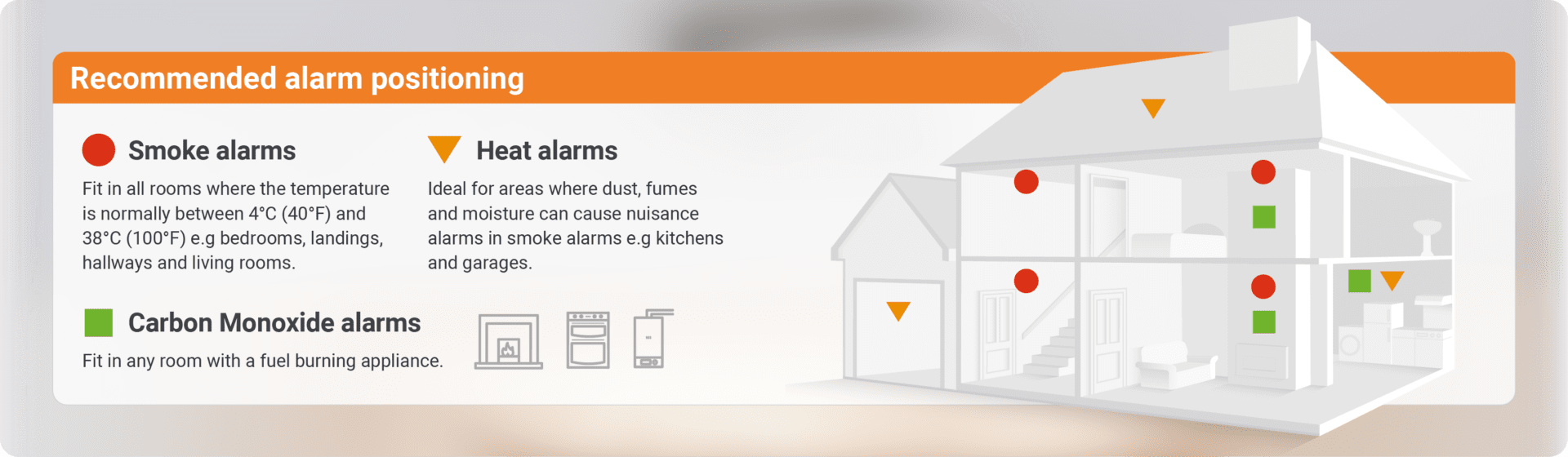
An alarm in the wrong place is one of the most common causes of false alarms. If your alarm started going off soon after it was fitted, check it is in the right room and not too close to doors or windows.
Do not fit smoke alarms where heavy dust or dirt could get into the sensor, as this can make them over sensitive. Avoid bathrooms, shower rooms and other damp, humid areas too, where moisture can set them off.
Our guide to installing your battery powered smoke alarm explains where each alarm should go. If you have Pro Connected alarms, our guide to interlinking alarms in the Pro Connected range covers setup and connection problems.
How do I clean my FireAngel alarm?
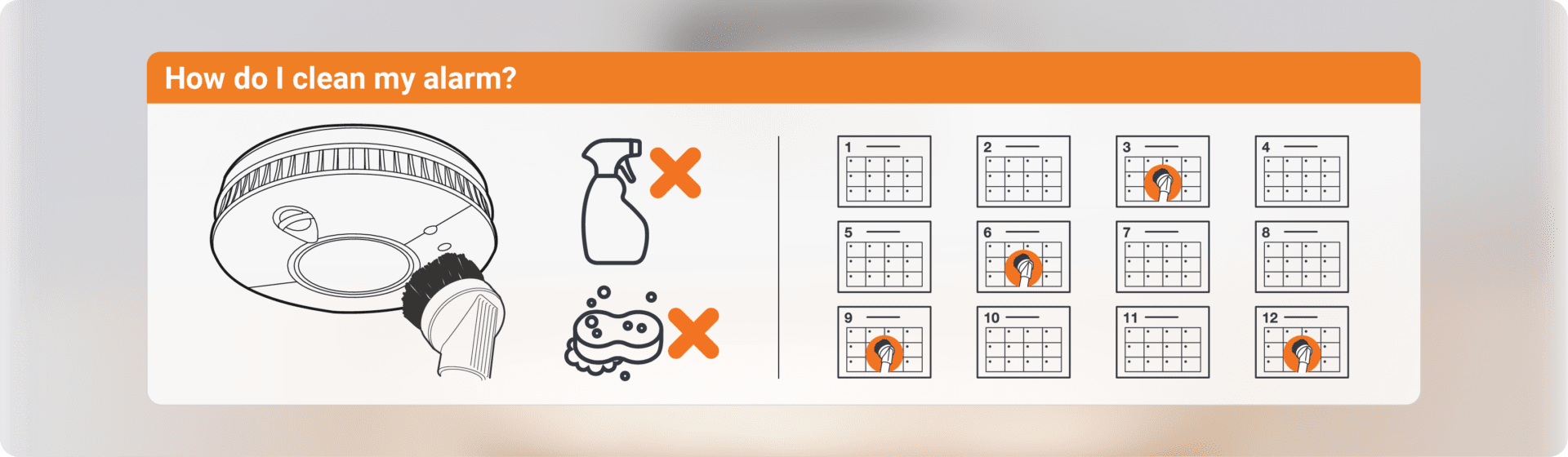
Clean your smoke and heat alarms every 3 months, so dust and insect webs do not stop the sensor working properly.
Run a vacuum cleaner with a soft brush attachment, or a hairdryer on a cool setting, around the edges and face of the alarm. Do not use solvents or cleaning products, as they can damage the sensor and circuitry. If cleaning sets the alarm off, press the large central test button to silence it.
If you see damage while cleaning, such as heavy staining or dust that will not shift, replace the alarm, as the sensor inside may be damaged.
Does cleaning really stop the beeping?
Often, yes. One customer contacted our Customer Support Team 10 days after a FireAngel smoke alarm was fitted in their hallway, following a stairlift installation. After cleaning the dust from the alarm as we advised, the false alarms stopped and no replacement was needed.
How to silence a low battery chirp

FireAngel smoke and heat alarms check their sensor and circuitry up to 8,500 times a day, through self-test technology. If a problem is detected, or the battery is low, the alarm chirps and the red LED flashes once every 40 to 60 seconds, depending on the model. You can silence a low battery chirp with the test button up to 10 times, but this only buys time: replace the battery, or the alarm if it has a sealed battery, as soon as you can.
If the alarm gives one double beep every 40 seconds, it has a fault rather than a low battery.
How to stop a mains powered FireAngel alarm beeping
This section covers the FP1640W2-R and FP1740W2-R mains powered smoke and heat alarms, the SW1R, SW10-EUT, HW1-R and HW10-EUT, and the ST-230, WST-230 and WHT-230, which are discontinued and no longer sold.
Why is my mains FireAngel alarm chirping?
There are two likely causes.
- It is not attached to the base plate correctly. When it is fitted correctly, the alarm shows a green LED with a red flash every 30 to 45 seconds. If you do not see this, remove the alarm from the base plate and reattach it.
- The wireless connection has a problem. If your alarms are wirelessly linked, unlearn the alarms and refit them. If the alarm is still chirping, remove it and replace it, or contact our Customer Support Team if it is still under warranty.
Why does my mains FireAngel alarm keep going off?
- Clean each alarm to clear dust and insect webs, following the cleaning steps above.
- If the alarm still sounds and is wirelessly linked to others, unlearn each alarm, refit it and wait to see if it sounds again.
- If your alarms are not wirelessly linked, or the false alarms carry on, remove the alarm whose red LED is flashing quickly. If your alarms are hardwired together, remove the alarm you suspect and see if the false alarms stop.
- Replace the alarm you removed, or contact our Customer Support Team if it is still under warranty.
For wiring and fitting help, see our guide to installing a mains powered smoke alarm.
Why is my FireAngel alarm flashing amber?
An amber LED, sometimes with a chirp, usually means the alarm is not attached to the base plate correctly. When it is fitted correctly, you will see a green LED flashing regularly, with a red flash every 45 seconds.
Remove the alarm from the base plate, reattach it, then test it twice. If you hear three beeps, it is now fitted correctly and the amber light should stop. If it does not sound, or keeps flashing amber or chirping, replace the alarm, or contact our Customer Support Team if it is still under warranty.
Why are my new FireAngel alarms going off or making long beeps?
If you have a mix of FireAngel alarms installed and linked together, that may be the cause. FireAngel One and Pro Connected alarms cannot be interlinked with each other, because FireAngel One uses Bluetooth and Pro Connected uses Wi-Safe. Every alarm on the system needs to be interlinked with alarms from the same range, such as other Pro Connected products. Read our FAQ on whether FireAngel One alarms can connect with Pro Connected alarms for more detail.
If all your alarms are from the same FireAngel range and are hardwired, check the connections and wiring on each one. If you find no problem, contact our Customer Support Team.
When to replace your FireAngel alarm
If your alarm has reached the end of its life or is no longer working properly, replace it without delay. The replace by date is on the back of the alarm.
If a sealed battery alarm is giving a low battery chirp and is no longer under warranty, the whole alarm needs replacing. If it is still under warranty, contact our Customer Support Team, or replace the alarm straight away so you stay protected.
Not sure if your alarm has a sealed battery? The FA6620-R, FA6629S and SCB10-R smoke alarms and the FA6720-R heat alarm have a sealed 10 year battery. The FA6611-R, FA6615-R and SB1-R smoke alarms have a replaceable battery.
Explore our full range of FireAngel smoke alarms.
Remember to test your alarms regularly. Our guide to maintaining and testing your FireAngel smoke alarm explains how.
What to do with your old alarm
Smoke and heat alarms are covered by the Waste Electrical and Electronic Equipment (WEEE) regulations. If your alarm has a crossed out wheelie bin symbol on the back, do not put it in your household rubbish. Take it to your local recycling centre or another WEEE collection point.
For more help, visit our support hub for guides, downloads and articles, or contact our Customer Support Team.


