Pregnancy is a time when many families start thinking more carefully about their health, their home and the environment their baby will grow up in. From preparing the nursery to making healthier lifestyle choices, there are plenty of things to consider before welcoming a new arrival.
But there is one potential household risk that can be easy to overlook: carbon monoxide.
Carbon monoxide (CO) is an invisible, odourless gas that can be produced when fuels such as gas, oil, wood and coal do not burn completely. Without a suitable alarm, it can be difficult to know when it is present in your home.
For expectant parents, understanding the risks of CO exposure is particularly important. Research has explored the relationship between carbon monoxide exposure during pregnancy and adverse outcomes, while emerging evidence is also investigating how exposure might affect early development.
So, what does the research tell us, where might CO exposure occur in the home, and what can you do to help protect your family?
Why is carbon monoxide a concern during pregnancy?
Carbon monoxide affects the body’s ability to transport oxygen. When inhaled, it binds to haemoglobin in the blood, reducing the amount of oxygen available to the body’s tissues.
During pregnancy, oxygen is essential for both the expectant parent and the developing baby. Carbon monoxide can cross the placenta, meaning that exposure affecting the mother can also affect the foetus.
The developing baby may be particularly vulnerable because it takes longer for the foetus to eliminate carbon monoxide from its system than it does for the mother.
This is one reason why CO exposure during pregnancy deserves attention, even when there are no immediately obvious signs of a problem.
What does the research say?
Research into carbon monoxide exposure in UK households has investigated the levels pregnant women may encounter in their homes and the factors associated with exposure (Place et.al, 2025).
The findings suggest that exposure can occur even in everyday domestic environments. The study also identified an association between maternal exposure and adverse pregnancy outcomes, including low birth weight. The researchers highlighted the importance of improved CO monitoring and strategies to reduce exposure, particularly among more vulnerable groups.
These findings do not mean that every instance of low-level exposure will cause harm. They do, however, underline why understanding potential sources of CO and taking sensible precautions are important during pregnancy.
Could everyday household activities contribute to carbon monoxide exposure?
When people think about carbon monoxide poisoning, they may imagine a major appliance failure or a serious household emergency. However, research suggests that household exposure can also be worth considering as part of everyday home safety (Place et. Al, 2025).
Fuel-burning appliances, including gas cookers, boilers, heaters and fires, can produce carbon monoxide if they are faulty, poorly maintained or not operating correctly.
A UK study examining CO exposure during pregnancy found that household levels tended to be higher at night, while maximum levels also increased during the early evening (Place et. Al, 2025).
The researchers suggested that gas cooking and heating could help explain these patterns. For example, cooking dinner or using heating as temperatures fall could coincide with changes in household CO levels. However, the study did not conclusively establish the causes of these fluctuations.
The research also found a relationship between exhaled CO levels and the number of smokers in a household, highlighting that smoking and fuel-burning appliances are both relevant considerations when discussing exposure.
The key takeaway is not that everyday cooking or heating necessarily makes a home unsafe. Rather, it is that CO awareness should be part of a wider approach to maintaining a safe home environment.

What about low-level carbon monoxide exposure and foetal development?
Scientists are continuing to investigate how carbon monoxide exposure might affect early development.
One experimental study examined the effects of CO exposure on chicken embryos, focusing particularly on the developing heart (Matias et.al, 2024). Researchers observed changes in heart structure, including increased thickness of the ventricular septum, the wall separating the heart’s two lower chambers.
Some structural changes were observed even at the lowest exposure level tested.
These findings raise questions about how CO exposure might influence early cardiac development. However, the study involved chicken embryos rather than humans, used relatively small numbers of embryos and did not establish whether the observed changes affected heart function.
It therefore cannot demonstrate that the same effects occur in human pregnancies.
Further research is needed to understand the relevance of these findings to human development. Nevertheless, this work adds to the scientific interest in understanding the potential effects of CO exposure and the importance of reducing avoidable risks.
Why carbon monoxide can be difficult to recognise
One of the challenges with carbon monoxide is that it cannot be seen, smelled or tasted. You cannot reliably identify its presence using your senses alone.
Symptoms of CO poisoning can include:
- Headaches
- Dizziness
- Nausea or vomiting
- Weakness or unusual tiredness
- Confusion or drowsiness
- Flu-like symptoms
- Chest pain or shortness of breath
Some of these symptoms can overlap with common experiences during early pregnancy, which may make it more difficult to recognise a potential problem (NHS, 2026).
Chronic exposure to lower levels of CO may also produce few obvious symptoms.
This is why it is important not to rely on how you feel to determine whether your home is safe. An appropriate, compliant carbon monoxide alarm provides an important means of detecting the gas, while regular appliance maintenance helps reduce the risk of CO being produced in the first place.
If you suspect carbon monoxide exposure, do not wait for symptoms to become more severe before taking action.
How can you help protect your home during pregnancy?
There are also practical steps you can take to improve carbon monoxide awareness at home:
1. Choose a compliant CO alarm with low-level monitoring
A compliant carbon monoxide (CO) alarm is an essential part of household safety, particularly during pregnancy. All CO alarms sold in the UK must meet the BS EN 50291-1 standard, which includes an alarm response of 90 minutes at 50 ppm. Some models also offer an early warning when lower levels of CO are detected.
The FireAngel FA3322 Digital Display Carbon Monoxide Alarm includes an Early Warning indicator that provides an audible and visual pre-alarm at readings as low as 10 ppm. This is not a full alarm, but it should not be ignored. Learn more about early warning indicators and what to do.
Low-level monitoring can help you become more aware of CO readings in your home. However, not all digital alarms provide low-level alerts; some only display readings. Check your chosen alarm’s features and instructions so you understand what its warnings mean and how to respond.
Choose an alarm that meets the standard and follow the manufacturer’s guidance on installation, placement, testing and maintenance. Ensure your home has appropriate alarm coverage for fuel-burning appliances, and if you rent, check with your landlord that required alarms are provided.
Low-level monitoring is an additional feature – not a replacement for a compliant alarm, suitable alarm coverage, regular appliance maintenance or taking urgent action if CO exposure is suspected.
2. Keep fuel-burning appliances properly maintained
Boilers, gas cookers, heaters, fires and other fuel-burning appliances should be installed and maintained appropriately.
Arrange regular servicing by a suitably qualified professional, and do not ignore signs that an appliance may not be operating correctly.
If you suspect an appliance is producing carbon monoxide, stop using it if you can do so safely and seek appropriate professional advice.
3. Know what to do if you suspect carbon monoxide exposure
If your CO alarm sounds, or you suspect carbon monoxide (CO) may be present, take the warning seriously.
Leave the property immediately and get everyone, including pets, into fresh air. Do not re-enter until you have been advised that it is safe to do so.
If anyone has symptoms or you suspect CO poisoning, seek emergency medical assistance and tell responders that CO may be involved.
In Great Britain, contact the National Gas Emergency Service on 0800 111 999 for advice about gas-related emergencies. Follow the relevant emergency service’s instructions.
If you are pregnant and concerned about possible exposure, seek prompt medical advice, even if symptoms seem mild or could be explained by pregnancy. You can also speak to your midwife or maternity team about having a carbon monoxide (CO) breath test, sometimes called a flow test, at a maternity appointment if you think you may have been exposed.
Familiarise yourself with our guide on what it means if your carbon monoxide alarm is beeping, and what to do.
Investing in a trusted alarm
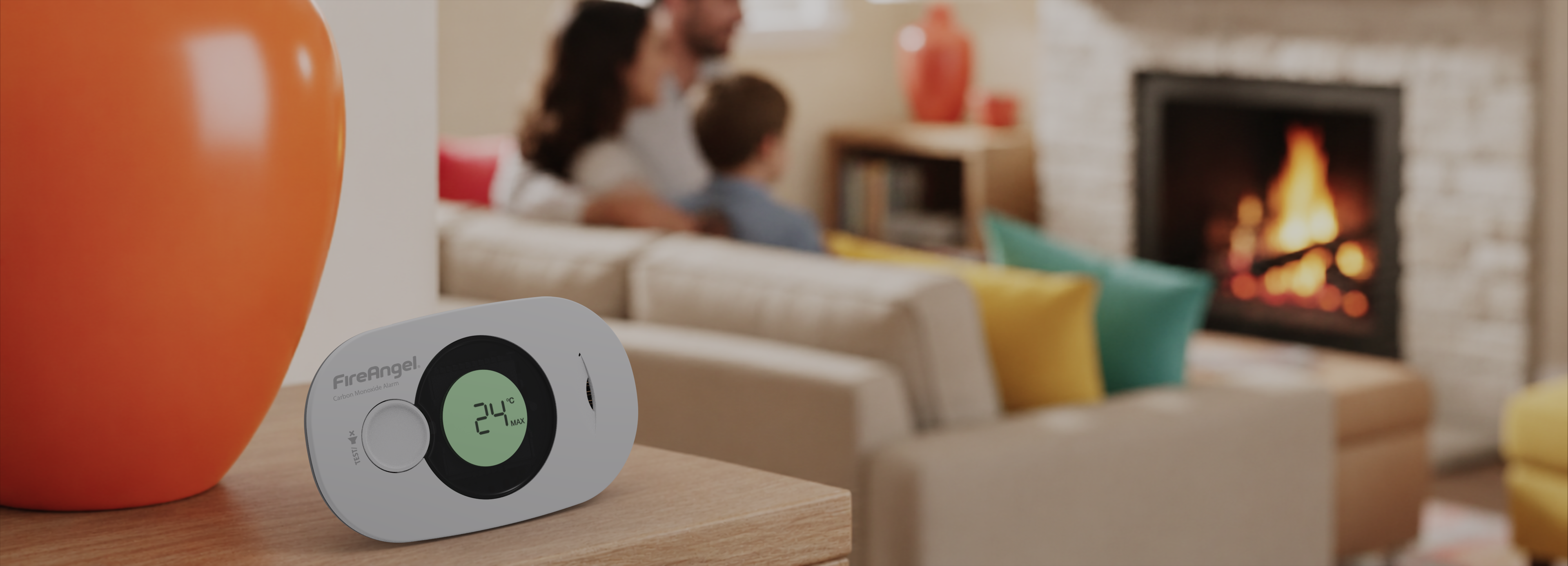
A reliable carbon monoxide alarm is an important addition to your home during pregnancy and beyond. The FireAngel FA3322 Digital Display Carbon Monoxide Alarm features a 10-year sealed-for-life battery, offering long-lasting protection as your family grows.
Recognised with Which? Best Buy status in November 2024, the FA3322 combines trusted performance with features designed to help you understand your home environment.
Its colour-coded LCD displays real-time CO levels in parts per million (ppm), alongside room temperature and humidity readings. An early warning function alerts you to sustained low-level CO, while an intelligent sensing algorithm increases the detection rate as CO levels rise. Separate alerts can also warn of prolonged temperature or humidity conditions.
Night Time Sensing automatically dims the LEDs while you sleep, without affecting detection – allowing you and baby a comfortable sleep.
With its long-life battery, clear digital display and recognised endorsement, the FA3322 is a dependable choice for families looking to invest in a trusted CO alarm.
Carbon monoxide awareness: a small step towards a safer home
Preparing for a baby involves plenty of decisions, but household safety is one area where a little knowledge can make a meaningful difference.
Research into carbon monoxide exposure during pregnancy highlights the importance of understanding potential sources of exposure, while ongoing studies continue to explore the effects CO may have on development.
Although there are still unanswered scientific questions, practical precautions remain important: ensure you have suitable CO alarms, maintain fuel-burning appliances and know how to respond if you suspect exposure.
For expectant parents, these steps can form part of a wider approach to creating a safer home for the whole family.
At FireAngel, we believe that awareness is an important first step towards protection. Our low-level CO alarm, FA3322 Digital Display Carbon Monoxide Alarm, offers an additional feature for households looking to improve their awareness of carbon monoxide.
Because when it comes to protecting your family, understanding the risks is a good place to start.
Explore FireAngel’s carbon monoxide safety and CO detector guide.


